Reset Computer
The “Reset Computer” plugin allows you to reset a computer. The reset process follows this workflow:
- Remove the computer object from all collections in SCCM
- Add the computer object to a previously selected OSD (Operating System Deployment) collection
- Set computer variables
- Assign software according to the definition via package branding or software inventory (see Software Allocation plugin)
- Perform Active Directory action (this part can also be disabled)
- Reset PXE status
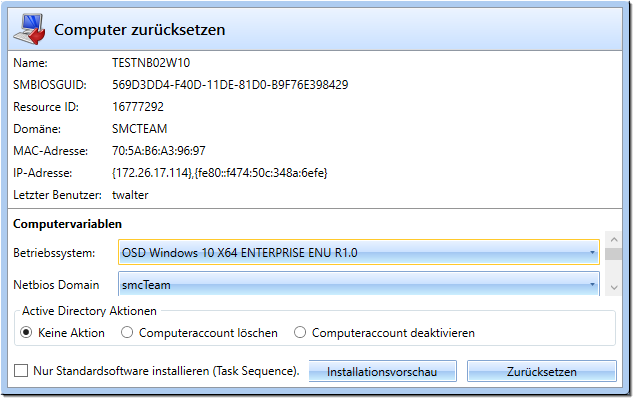
The selection and input options for computer variables can be configured as desired. (See Dynamic GUI Editor)
Plugin configuration
| Name | Description | Default value |
| DatabaseConnection | Specifies the database on which the SQL queries are to be executed. | SCCMManager |
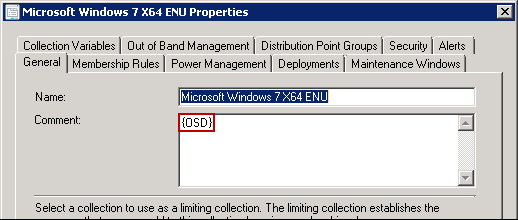
| DynamicOSD | Specifies whether SCCM collections that include “{OSD}” in their description should automatically be made available for selection. | True |
| DynamicOSDFirst | Specifies whether the OSD collections are listed first in the list | False |
| DynamicOSDQuery | The SQL query for retrieving the OSD collections |
Click to view
|
| EnableActiveDirectoryActions | Specifies whether Active Directory operations are allowed to be performed during a reset | False |
| OsdVariableXml | Describes the GUI object in which the OSD collections are listed |
Click to view |
| SoftwareAllocationConfig | Specifies which “SoftwareAllocation” plugin configuration should be used | Default |
- DynamicOSD: Enables / Disables dynamic loading of OSD collections
- EnableActiveDirectoryActions: Enables / Disables the selection of AD actions
When DynamicOSD is enabled, all collections whose comments contain the value {OSD} are automatically available for selection within the plugin interface.
Configuration - GUI
To meet individual requirements, Client Creator features a dynamic graphical user interface (GUI) that allows, for example, any preconfigured OSD variables to be made available, which can then be selected within Client Creator. The GUI for this purpose can thus be customized through configuration.
Currently, the “ComboBox” and ‘TextBox’ controls are supported. Event-based rules can be configured to map dependencies within the controls/variables. Example: “Selection in ComboBox A” influences “Entry in ComboBox B.” Each control represents a variable. Each control can also be deactivated or set to invisible (this is also possible via a rule). This opens up various possibilities. For example, rule-driven, invisible controls can be used to set multiple variables directly with a single selection—variables that the user may not be intended to see.
This interface is configured using the Dynamic GUI Editor.
Default Plugin Integration
- Assembly: ResetComputerPlugin
- Name: RESET_COMPUTER (gets translated)
- Icon: workplace_out.png
- SelectedComputer: Single